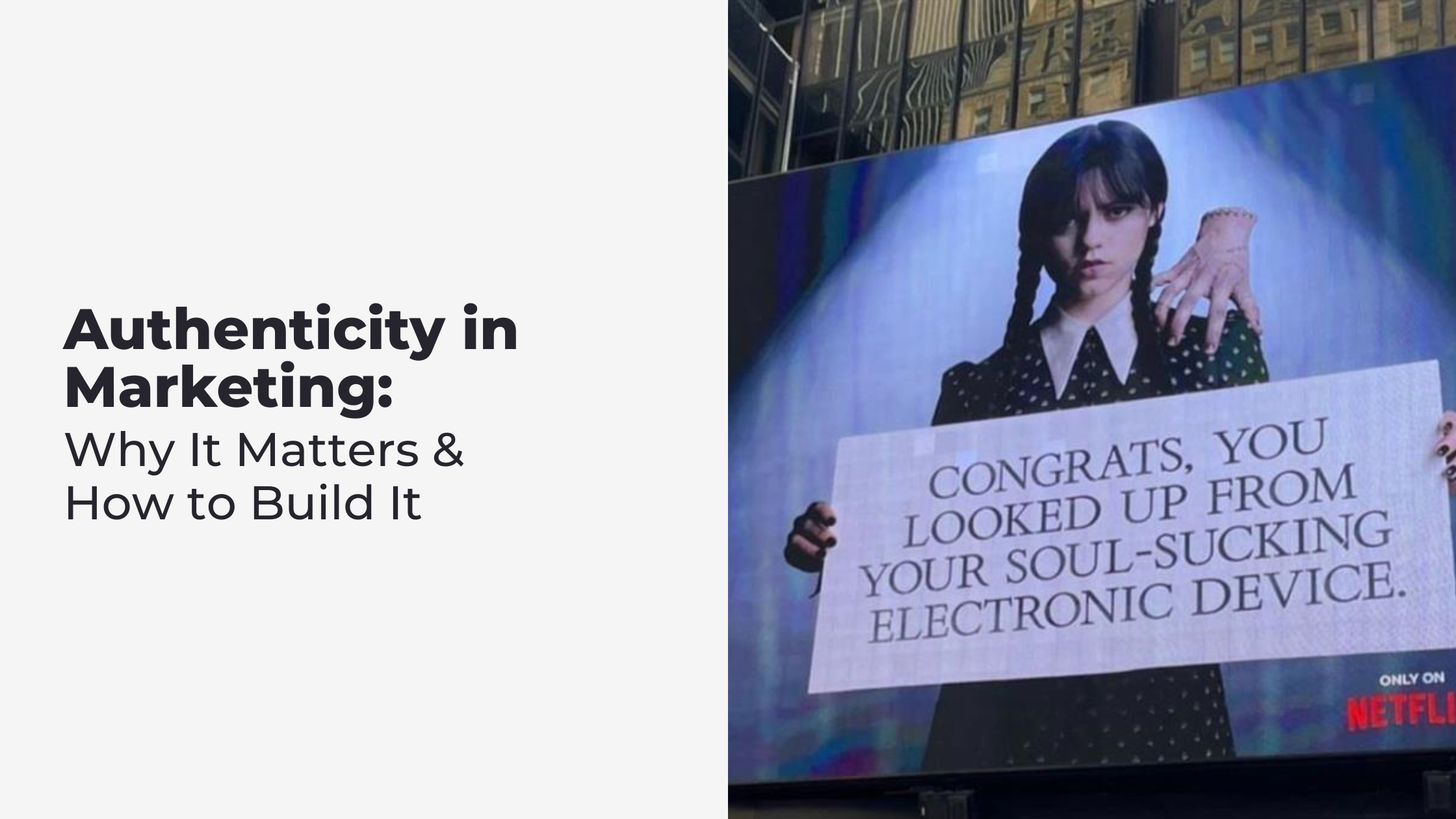
At WGA, we’ve seen the same pattern across industries: the brands customers trust most aren’t the ones with the slickest ads, but the ones that feel real. Authenticity in marketing means telling true stories, staying faithful to your core values and building open, honest relationships with your audience, rather than relying on fake or overly polished sales tactics. It shows up in what you say, how consistently you say it and whether your actions match your promises. This guide explains what authentic marketing looks like, why it matters more than ever and how to build it into your strategy.
What Is Authenticity in Marketing?
Authentic marketing is marketing that customers believe. It reflects who your company actually is: what you sell, how you operate, what you care about and how you treat people. When customers interact with your business after seeing your marketing, the experience should match the message.
Authentic vs. “Performative” Marketing
| Authentic Marketing | Performative Marketing |
| Based on real values and proof | Based on what sounds good |
| Consistent over time | Changes with every trend |
| Backed by action | Backed only by words |
| Shows real people and results | Relies on staged perfection |
| Admits limitations | Overpromises |
Authenticity also has limits. It doesn’t mean oversharing every personal detail or posting emotional rants. And it isn’t virtue signaling: promoting a social cause just to look good, without real commitment or action, comes across as fake and can damage your reputation.
The Core Elements: Honesty, Consistency and Transparency
- Honesty: Make claims you can back up, and be clear about what your product or service does and doesn’t do.
- Consistency: Keep your values and message steady instead of chasing every viral trend or reshaping your identity to please a passing crowd. Consistency builds a sense of safety and trust.
- Transparency: Show what happens behind the scenes, own your mistakes when things go wrong and take visible responsibility for fixing them.
Why Authenticity in Marketing Matters More Than Ever
Consumer Trust Is Harder to Earn
People have become skeptical of advertising, influencer posts and online reviews. Industry surveys have repeatedly found that roughly 86% to 90% of consumers, including millennials and Gen Z, consider authenticity and trust key factors in deciding which brands to buy from. When people can’t tell what’s real, they reward brands that make it easy to believe them.
Content Saturation and AI-Generated Noise
Consumers scroll past an overwhelming amount of content every day, and AI tools now make it easy for any company to produce endless polished posts, images and articles. As generic content multiplies, it becomes less memorable. Real stories, recognizable people and genuine opinions stand out far more than corporate perfection.
How Authenticity Drives Loyalty and Word of Mouth
When customers trust a brand, they don’t just buy once. They come back, recommend it to friends and defend it online. Authentic brands turn casual buyers into repeat customers and advocates, which lowers marketing costs over time because customers do part of the selling for you.
Examples of Authentic Marketing (and Campaigns That Backfired)
Brands That Got It Right
- Patagonia: Its 2011 “Don’t Buy This Jacket” ad encouraged shoppers to think twice before buying, even from Patagonia. The message matched the company’s long-standing environmental commitments, so it felt credible rather than gimmicky.
- Dove: The Real Beauty campaign, launched in 2004, featured everyday women instead of professional models. Its staying power comes from a consistent message repeated over two decades.
- Small businesses: Local shops, contractors and restaurants often build authentic brands simply by showing their owners, teams and real work on social media.
When Authenticity Fails: Lessons From Brand Missteps
- Pepsi (2017): An ad that borrowed imagery from protest movements was pulled within days after widespread criticism that it trivialized serious issues. Lesson: don’t borrow a cause your brand hasn’t earned.
- Coca-Cola (2024): An AI-generated version of its classic holiday ad drew criticism for feeling soulless. Lesson: technology can’t replace the human warmth people associate with a beloved brand.
- Fake reviews: Businesses caught buying or fabricating reviews lose credibility quickly and face legal risk, as covered below.
How to Build an Authentic Marketing Strategy
Start With Real Values and Proof, Not Slogans
Lead with your “why”: the real purpose behind your business and the problem it was created to solve. Then back it up with proof:
- Write down the values that actually guide your decisions.
- Identify real examples of those values in action.
- Collect evidence such as results, certifications, case studies and customer stories.
- Remove claims you can’t support.
Put Customers and Employees at the Center of Your Stories
Your customers and team are your most believable storytellers. Feature:
- Customer success stories and case studies
- Before-and-after results with real clients, with permission
- Employee spotlights and day-in-the-life content
- Q&As with team members who serve customers directly
People trust people more than logos.
Show the Process: Behind-the-Scenes and Founder-Led Content
Showing how your work gets done builds credibility. Share how products are made, how projects unfold, what a typical workday looks like and why you make certain decisions. Founders and leaders who speak directly to customers, through videos, posts or newsletters, give the brand a recognizable human voice.
How to Stay Authentic Across Marketing Channels
Social Media and User-Generated Content
- Use real photos and videos instead of only stock imagery
- Reply to comments and messages in a human tone
- Reshare customer photos, reviews and videos with permission
- Address criticism publicly and respectfully
User-generated content works because it comes from customers, not the brand.
SEO and Content Marketing: Experience-Driven Content (E-E-A-T)
Search engines increasingly reward content that shows real expertise. Google’s quality framework, known as E-E-A-T, stands for experience, expertise, authoritativeness and trustworthiness. To create content that reflects it:
- Write from firsthand experience, with real examples and data
- Include author bios with genuine credentials
- Cite trustworthy sources
- Update content when information changes
Authentic content and strong SEO increasingly point in the same direction.
Reviews and Testimonials
Ask happy customers for honest reviews, respond to every review, both positive and negative, and never edit or invent testimonials. A mix of strong reviews and thoughtful replies to criticism is more believable than a perfect five-star wall.
Authenticity in the Age of AI
Using AI Without Losing Your Brand Voice
AI can speed up research, outlines, first drafts and editing. To keep content authentic:
- Create a brand voice guide and use it to shape every AI draft
- Add real stories, data and opinions that only your team has
- Have a person review every piece for accuracy and tone
- Never use AI to invent customers, quotes or experiences
Should You Disclose AI-Generated Content?
There’s no single rule that covers every use of AI in marketing, but transparency is the safer path. Many social platforms now require labels for realistic AI-generated images and videos. A good standard: if your audience would feel misled to learn something was made by AI, such as a realistic image of a person or a testimonial, disclose it or don’t use it.
The Rules Behind Authentic Marketing: FTC Guidelines
Influencer and Endorsement Disclosures
If you pay creators, give them free products or have any other material connection, that relationship must be disclosed. The FTC’s Disclosures 101 for Social Media Influencers explains that disclosures should be clear, hard to miss and placed within the endorsement itself, using simple terms like “ad” or “sponsored.” Endorsers also can’t claim experiences with products they haven’t tried.
The FTC Ban on Fake Reviews and Testimonials
In 2024, the FTC finalized a rule banning fake reviews and testimonials. It prohibits, among other things:
- Reviews and testimonials attributed to people who don’t exist, including AI-generated ones
- Buying positive or negative reviews
- Undisclosed reviews from company insiders
- Suppressing negative reviews through threats or intimidation
- Buying fake followers or views
Authenticity isn’t just good marketing; in many cases, it’s the law.
How to Measure Authenticity in Marketing
Trust Signals: Sentiment, Reviews and Repeat Customers
Authenticity shows up in measurable ways:
- Review ratings and volume across Google and industry platforms
- Social sentiment in comments, mentions and shares
- Repeat purchase and retention rates
- Referral and word-of-mouth leads
- Branded search growth, as more people look you up by name
- Survey results on trust and likelihood to recommend
A Quick Brand Authenticity Audit Checklist
Ask these questions about your current marketing:
- Can we prove every claim we make?
- Do our ads match the real customer experience?
- Are real customers and employees visible in our content?
- Is our message consistent across our website, social media and ads?
- Do we respond openly to negative feedback?
- Are endorsements and paid partnerships clearly disclosed?
- Is any AI-generated content reviewed and used honestly?
- Do our actions support the values we promote?
If you answer “no” to any of these, that’s where to start.
Build a Brand People Believe In With WGA
Authenticity can’t be faked, but it can be communicated clearly and consistently. As a full-service marketing and advertising agency in Chicago, WGA helps businesses define their brand story, create content built on real expertise and customer experiences, manage social media and reviews, and produce campaigns that feel human. We’ll help you turn what makes your business genuine into marketing that earns trust and drives growth.
Ready to build a more authentic brand? Contact our team, book a 30-minute strategy call.